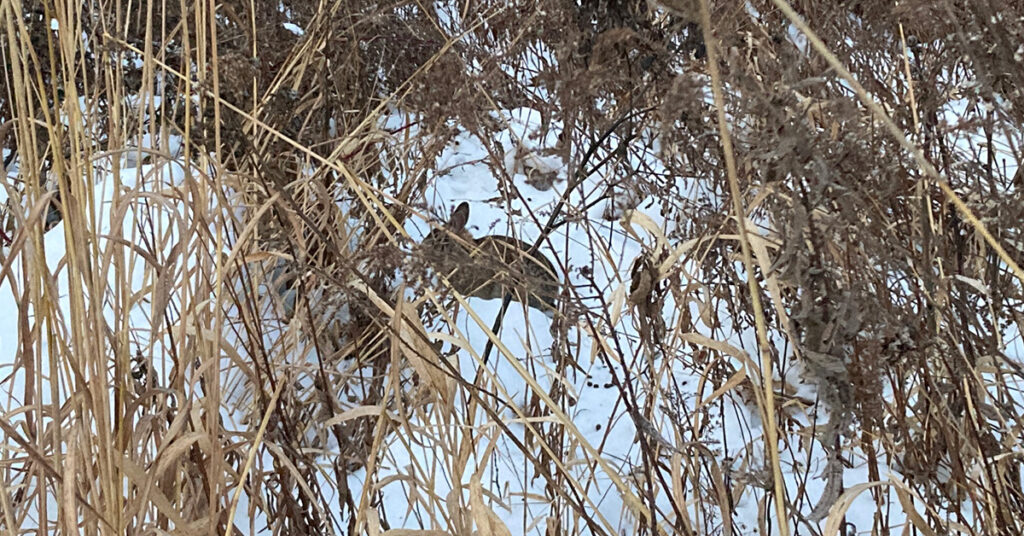
Cottontails avoid predators in many ways, but camouflage is their best defense.
The Eastern cottontail is the most common cottontail rabbit found in the United States and the only type found in Wisconsin. They are common in urban and residential areas and will stick around year-round. While it is not uncommon to spot a cottontail during the day, they are most active at night.
Cottontails have many predators, including hawks, owls, foxes, snakes, and even dogs and cats. Because of this, they need to be quick. A cottontail can hop at speeds of up to 18 miles per hour to escape danger, zigzagging across the ground to make it harder for predators to catch them. If a rabbit can hide from a predator, it will. A cottontail’s coat is made up of browns and grays that help them blend into their environment. They will freeze in place, hoping a predator does not see them. If that does not work, they will try to fight off the predator with their strong legs and teeth until they can make a run for it.
With so many predators, cottontails have many babies to sustain their population. They can breed several times per year, with each litter containing three to eight kits. In Wisconsin, breeding season runs from March through October, so baby rabbits may be seen from spring through fall. Kits are left in shallow ground nests made of vegetation and fur, and the mother visits briefly at dawn and dusk to feed them. Rabbits grow quickly and are able to leave the nest after about three weeks.
In the fall, cottontails begin to build up an extra layer of fat to help them survive the winter. This fat is called brown fat, or brown adipose tissue. It has the ability to store energy and help them stay warm. A cottontail’s main concern in the winter is finding food. They often resort to eating bark from shrubs and trees or even tree buds until more food is available.
Interested in similar topics? Explore more articles tagged with Mammals.