Sandhill cranes are back!
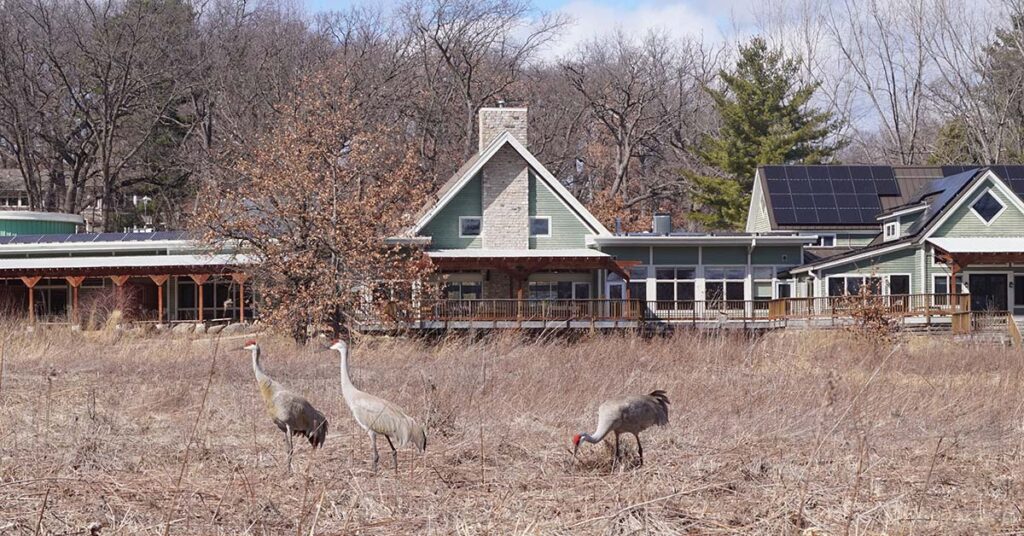
This year, the mated pair of cranes that nest every year around the Nature Center came back with their grown-up colt! Soon, the colt will leave its parents to join a group of young cranes called bachelor flocks. They will stay together until they are ready to find a mate of their own, usually around age four.
Breeding sandhill cranes select a grassy nesting site near open water to lay their eggs. By mid-May, crane colts are already hatching and are ready to leave the nest for short adventures just 8 hours later. They will stay close to their parents for 9 to 10 months, following them south during the fall migration.
In spring, cranes are admired for their dancing skills, but this ritual can happen all year round. If you are lucky enough to experience this display, you will notice that the dance begins with a low bow. Then it quickly escalates to a synchronized spectacle of jumping, wing spreading, and feet throwing. For dramatic effect, sticks or plants may be plucked off the ground and thrown into the air. The pair will elegantly bow to one another once again before repeating this series of movements.
Breeding pairs also perform unison calls to reinforce their bond and protect their territory. When calling, the male points his neck and bill straight up to the sky and performs a short single note, while the female responds with two notes and points her bill horizontally. This call can be heard up to 2.5 miles away!
Interested in similar topics? Explore more articles tagged with Birds, Spring Migration, and Sandhill Cranes.