What’s blooming in the Kindergarten Woods?
Spring ephemerals are the first perennial plants to emerge each year. They have a short growth and reproduction phase, with a brief blooming period followed quickly by seed production. As the season progresses, their leaves wither away, leaving only underground structures for the rest of the year. This strategy allows them to take advantage of sunlight filtering through the bare branches of deciduous woodlands early in the season.
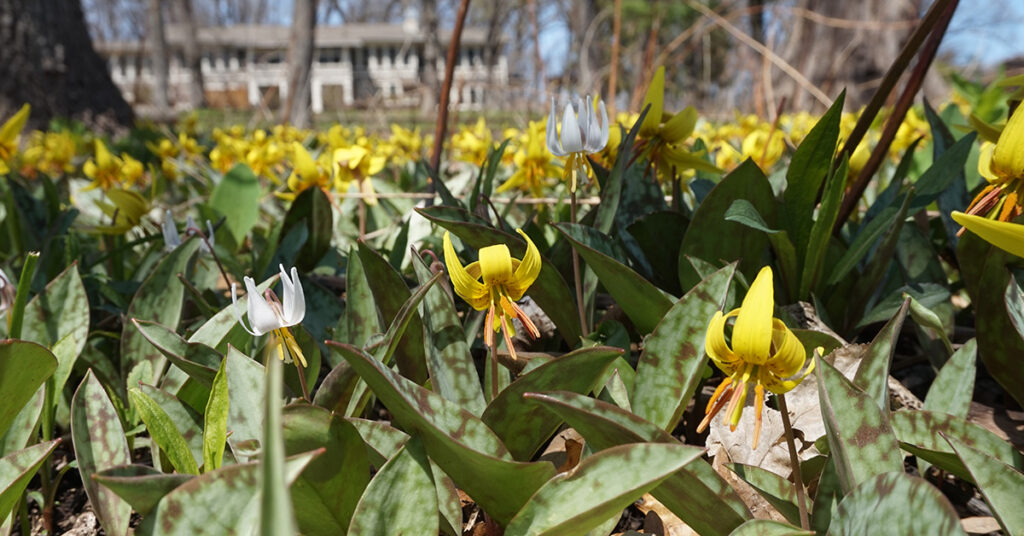
As spring unfolds, a variety of ephemerals bloom across the forest floor. Right now, it is dotted with splashes of yellow, white, and blue from trout lilies and Virginia bluebells. These wildflowers attract pollinators and capture sunlight before the canopy fills in above. You may also spot Dutchman’s breeches, trilliums, mayapples, Virginia waterleaf, and wild ginger during this time.
Trout lilies can be yellow or white and are named for their distinctive leaves. The pointed, waxy foliage is mottled and resembles the pattern of a brook trout. It can take up to seven years for a trout lily to produce its first flower, but once established, the plant can persist for centuries, spreading through underground corms and forming long-lived colonies across the forest floor.
Virginia bluebells begin as pink buds and gradually turn soft blue as they mature. Their smooth, oval leaves grow alternately along the stem, and their flowers form a tube shape from fused petals. Because of this shape, they rely on long-tongued bees, butterflies, and moths for pollination.
Interested in similar topics? Explore more articles tagged with Spring Ephemerals, Trout Lilies, and Virginia Bluebells.