A native perennial found throughout Eurasia and North America.
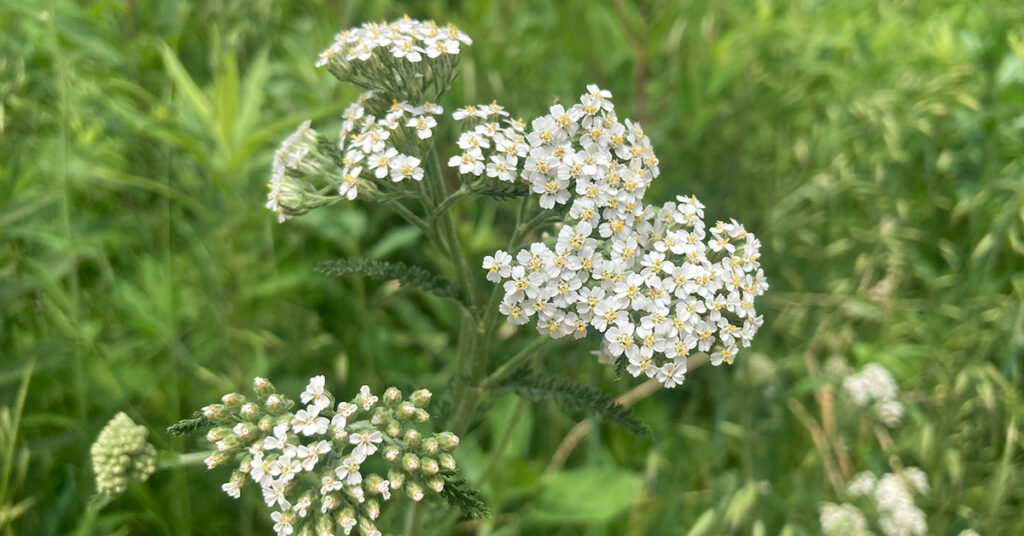
Common yarrow thrives in dry, sunny habitats such as prairies, fields, and deciduous woodlands. Its tight, flat clusters of flowers have a distinctive fragrance, often described as a blend of chamomile and pine. Each tiny flower has five white petals surrounding a cream- to pale yellow-colored center. The alternate leaves are also fragrant and resemble delicate fern fronds, becoming progressively smaller toward the top of the plant.
Across many cultures, common yarrow (Achillea millefolium) has been used for centuries as a medicinal herb. Its scientific name refers to the warrior Achilles in Greek mythology, who is said to have used the plant to treat wounds during the Trojan War. Externally, yarrow has traditionally been used in poultices and ointments to help heal wounds, cuts, and bruises. Its anti-inflammatory and antiseptic properties may help reduce swelling and prevent infection. Yarrow is also well known for its ability to help reduce bleeding and repel insects.
Want to make a poultice? Start by harvesting fresh common yarrow leaves and chop them finely, then mash them into a paste using a mortar and pestle with a small amount of water. Place the herbal mixture into a piece of muslin, then apply it directly to the affected area. Leave it on for about 30 minutes and repeat as needed. You can also add common plantain to the poultice, as both herbs are excellent for skin support.
Always be sure you can confidently identify wild plants before harvesting or using them. This information is for educational purposes only and is not a substitute for professional medical advice.
Interested in similar topics? Explore more articles tagged with Prairie Blooms, and Medicinal Plants.