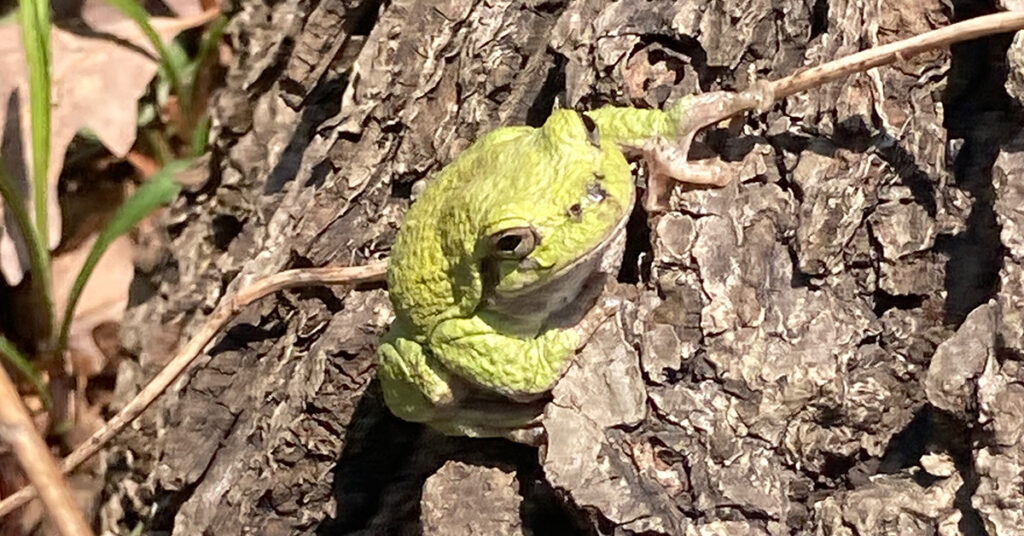
Have you ever seen a frog sticking to a window or the side of a building?
You’ve likely spotted a treefrog! These fascinating creatures are equipped with enlarged toe pads that secrete a sticky mucus, allowing them to climb smooth vertical surfaces. They can even move upside down across broad leaves with ease.
Did you know that Wisconsin is home to two nearly identical species of gray treefrogs? The Eastern Gray Treefrog and Cope’s Gray Treefrog look virtually identical. Scientists and wildlife enthusiasts distinguish them primarily by their calls. Cope’s Gray Treefrog produces a faster, higher-pitched trill, while the Eastern Gray Treefrog has a slower, more musical trill.
These frogs can also change their skin color to help them blend in with their surroundings. They may appear gray, green, or light in tone depending on the surface they are resting on, such as tree bark or leaves. They change color by adjusting special pigment cells in their skin that respond to light, temperature, and moisture.
Even more surprisingly, some resilient frogs can survive freezing winter conditions. The Eastern Gray Treefrog is especially well known for this ability. It produces natural cryoprotectants, such as glucose, that help protect its cells from ice damage while much of its body freezes. During this state, the frog’s heartbeat and breathing stop. In spring, they thaw out and hop away.
Interested in similar topics? Explore more articles tagged with Amphibians, Frogs, and Tree Frogss.